
Meeting Andrei Pandele, a Veteran of Romanian Documentary Photography

Being in Bucharest on holiday this August, I felt it was the right time to do something I had wanted to do for a long time. Knowing that Mr Andrei Pandele lives in Bucharest, I got in touch with him and we arranged for me to visit. I wanted to sit down with him, listen to his stories and, above all, talk about his photographs and the Bucharest he has documented over so many years.
For those who may not know his work, Andrei Pandele was born on 27 August 1945 in Bucharest. He is an architect, urban planner and photographer, and graduated from the Ion Mincu Institute of Architecture in 1968. Beyond his profession as an architect, photography became a way for him to preserve the memory of a Romania undergoing profound change.
He photographed Bucharest and everyday life during the communist regime, including the demolitions and major transformations the city underwent during the final years of Ceaușescu’s rule. He later documented the Romanian Revolution of December 1989 and the Romania that emerged afterwards.
Today, many of his photographs have a value that goes far beyond photography itself. They are visual documents of an era, preserving people, streets and places that have either changed dramatically or no longer exist.
That is precisely why I wanted to meet him. Not for a formal interview, but for a conversation between two photographers from different generations, about photography, people, Bucharest, and what it means to document the time in which you live.

I have always been drawn to Andrei Pandele’s photographs, to his compositions and, above all, to the clarity with which he documented certain moments and periods in Bucharest’s history. During our meeting, I had the opportunity to discover the stories behind many of these images.
He explained why he chose to photograph certain scenes, what was happening at that particular moment, who the people in the photographs were, and the wider context that, simply by looking at the image today, you could never fully understand.
It was fascinating to hear these stories directly from the person who was there and pressed the shutter. Suddenly, photographs I had known for years took on an entirely new dimension.

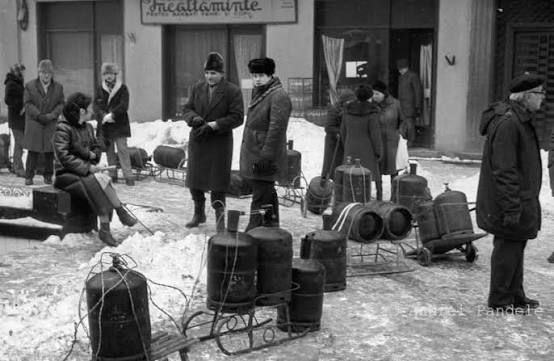
One of the photographs that stayed with me is the image of a soldier shaving around Christmas. Andrei Pandele told me the story behind the photograph and recalled with nostalgia the soldier’s words: “I have to shave. Christmas is coming, and I’m not a pagan.”
It is a simple sentence, but one that says a great deal about that time and about the place that faith and tradition held in people’s lives. Suddenly, the photograph is no longer simply an image of a soldier shaving. It becomes a small testimony to the person behind the uniform and to Romanian society at that time.

A warm welcome
The welcome I received at his home was incredibly warm and natural. When I arrived, he was there with his wife, working at his computer. We immediately started talking about photography. He showed me photographs from his archive and shared the stories behind them.
At one point, he picked up my Leica, looked it over and spent a little time playing with it. He was impressed by the camera, its size and the way it felt in his hands.
It was one of those simple, beautiful moments of the visit. Nothing formal, just two photographers talking about photography and the cameras they use to tell their stories.

One of the photographs we discussed during the visit was an image of a woman making a gesture with her hands.
I asked Mr Pandele what she was trying to communicate. His answer was simple:
“S-au gătat ouăle.” — “There are no more eggs.”
There were simply no eggs left to sell to the people.
It is a small detail, but one that completely changes the way you read the photograph. Without knowing the story, her gesture could mean almost anything. Once you know the context, however, the image becomes a document of everyday life and of the shortages people experienced during that period.
This is exactly why hearing the stories behind these photographs directly from the person who made them was so valuable.
And then came the story of Henri Cartier-Bresson
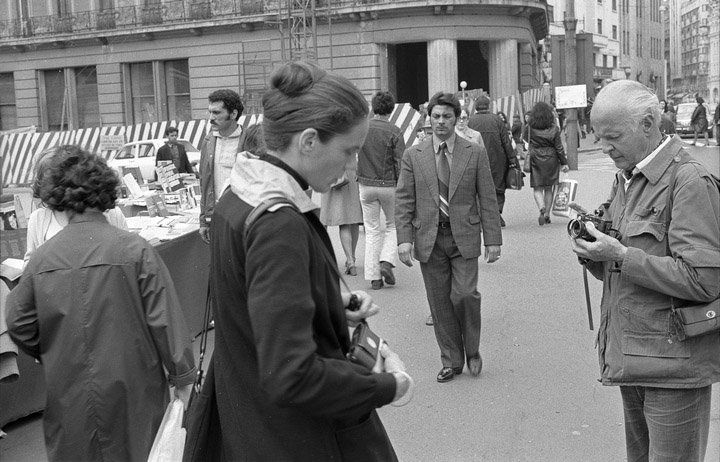
Perhaps the story that fascinated me most that day was about Henri Cartier-Bresson.
Mr Pandele told me about meeting Cartier-Bresson in Bucharest and waiting for him at Gara de Nord, Bucharest’s main railway station. He remembered how impressed he was when he first saw him.
In front of him was not the imposing figure one might imagine when thinking about one of the greatest photographers in history. Instead, there was a small, modest man, simply dressed, wearing a vest with many pockets, carrying an old, worn bag and two cameras.
After they met, Cartier-Bresson had a simple request:
“Take me to the nearest market.”
Close to Gara de Nord there was an old, rather modest market. Nothing glamorous, nothing particularly spectacular. But that was exactly the kind of place that interested Cartier-Bresson.
They went there and photographed together.
And this is where Mr Pandele told me something I found particularly fascinating.
“I photographed people from two metres away. He photographed them from less than one metre.”
Hearing this directly from someone who had actually stood beside Cartier-Bresson and watched him work was extraordinary.
He described Bresson as extremely fast and instinctive as a photographer. He moved close to people and reacted immediately to what was happening around him.
I connected strongly with this part of the story because I also work very close to people in my own photography. For me, being close is not simply about focal length or physical distance. It is about being inside the moment rather than observing it from somewhere outside.
There was another small detail from that encounter that I loved.
Later, Mr Pandele and his wife were invited to dinner with Cartier-Bresson. When they arrived, Bresson took his two cameras and simply placed them on the floor, in the corner of the room.
Why the corner?
Because, as Mr Pandele explained to me, there the cameras could not fall, and it would also be extremely difficult for someone to take them unnoticed. To remove them, someone would have to physically approach that corner.
Such a simple and ingenious idea.
And somehow, I think these little details tell us just as much about a photographer as technical discussions about cameras and lenses.
Behind the legendary name of Henri Cartier-Bresson was a working photographer: fast, practical, observant, close to people and completely focused on what was happening around him.
Listening to Andrei Pandele tell these stories was something special. These were not stories I had discovered in a photography book or read somewhere online. I was sitting in his home, listening to the memories of someone who had actually been there.
And perhaps that was the most valuable part of the entire visit.
Photography preserves moments, but photographers also preserve stories.
Sometimes, decades later, those stories allow us to look at the photographs again and finally understand what was happening just outside the frame.
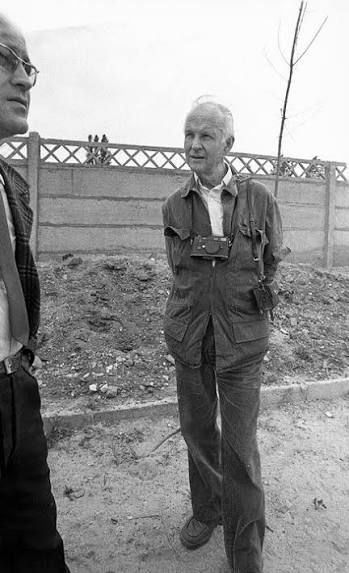
The End of the Visit
Towards the end of our meeting, I gave Mr Pandele a signed copy of my book, London in Frames, as a small gesture of gratitude for welcoming me into his home and sharing so many of his stories with me.
In return, he gave me one of his own books, La Biserica Icoanei , featuring his photographs and personally signed by him. It was a beautiful exchange and a meaningful way to end our time together.
For me, the entire experience meant a great deal. There is something very different about meeting the person behind the camera, sitting together in his home and talking almost like two old friends about photography, life and the passion we share.
And perhaps this is what stayed with me most.
What photographers from his generation began decades ago, we, the new generation of photographers, have a responsibility to continue.
The cameras may change. The streets may change. The world itself is constantly changing.
But our responsibility remains the same: to observe, to photograph and to document the world as it is.
Because one day, the ordinary moments we photograph today may become the visual memory of our time.


Comments